Amid rising geopolitical tensions, the traditional mechanisms of global cooperation are being tested as never before. This year, we have witnessed violent conflicts, humanitarian crises, escalating climate disasters and a fraught global economic landscape marked by increasing trade protectionism. In this context, South Africa’s G20 presidency was more than a diplomatic rotation; it was a crucial stress test for multilateralism.
The Think 20 (T20) engagement group, the “ideas bank” of the G20, played a pivotal role in this. Steered by a trio of leading South African think tanks – the Institute for Global Dialogue, the South African Institute of International Affairs, and the Institute for Pan-African Thought and Conversation – the T20 provided intellectual support to G20 South Africa, helping it chart a more cohesive path forward for the bloc amid rising fragmentation.
The T20’s mission is to bring together a global network of experts, academics, and think tanks from both G20 member countries and beyond to provide rigorous, evidence-informed recommendations linked directly to the G20’s agenda. As the fourth and final presidency in a succession of Global South G20 presidencies, the South African G20 presidency had a clear goal. The T20 South Africa’s mandate was to help it ‘consolidate and sustain’ the progress made by Brazil, India and Indonesia on issues critical to the Global South. The G20’s priorities under South Africa’s presidency were strategically aligned with those of its three predecessors, focusing on a strong developmental agenda that included disaster resilience, debt sustainability for low-income countries, financing for a just transition and harnessing critical minerals for inclusive growth and sustainable development.
The T20 also dovetailed its efforts with the G20’s agenda, using its five task forces to focus on these priorities:
- Trade and Investment
- Digital Transformation
- Financing for Sustainable Development
- Solidarity for the Achievement of the SDGs
- Accelerating Climate Action and the Just Energy Transition
Under South Africa’s leadership, the T20 set about to amplify the voices of the Global South. A powerful marker of this commitment to inclusivity was the approach to task force leadership and co-authorship. By actively seeking to balance expertise from the Global North and Global South, the T20 built genuine consensus and legitimacy, ensuring that its policy recommendations reflected diverse, on-the-ground realities.
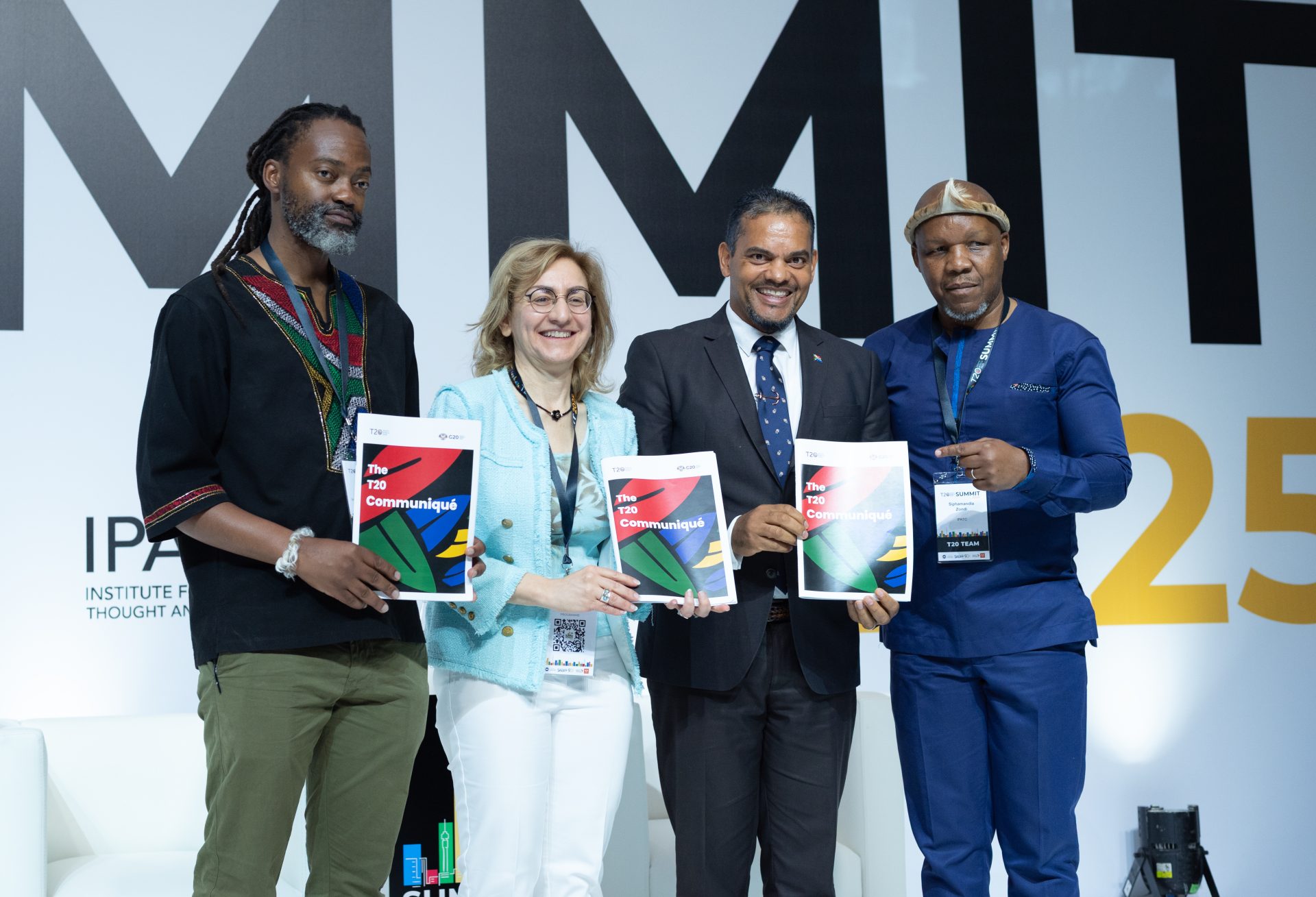
The five task forces have produced a body of work that is rigorous and highly responsive to the pressing needs of our time, overseeing the production of 110 policy briefings authored by experts from across different regions. These contributions are reflected in the T20 Communiqué, which outlines high-level recommendations for the G20. Beyond the Communiqué and policy briefs, the T20 published shorter commentaries throughout the year. These documents offer in-depth perspectives and draw on valuable lessons from various countries.
Some of the significant policy recommendations put forth by T20 South Africa include:
- Closing the SDG financing gap: The T20 suggests that the G20 should lead reforms of the global financial system and advocate for progressive fiscal policies. This includes implementing a global wealth tax, reforming financial institutions to better assist vulnerable nations, and championing comprehensive debt relief.
- Strengthening the World Trade Organisation (WTO): To reform the global trading system, the G20 should empower the WTO by increasing its funding and making its decision-making more flexible to help pass pro-development agreements. Additionally, the dispute settlement system should be reformed, potentially using the Multi-Party Interim Appeal Arbitration Arrangement (MPIA) as a model.
- Developing integrated data governance: The T20 calls for the creation of national and regional data governance frameworks that are comprehensive, rights-promoting, equitable and just.
- Addressing debt sustainability: The T20 proposes compelling ideas on debt sustainability, lowering the cost of capital and reforming the international financial architecture.
- Reforming social protection systems: To reduce inequality, the T20 recommends a comprehensive restructuring of social protection systems.
- Building stronger food systems: The T20 advocates for a more integrated governance approach that incorporates urban agriculture, stronger regulation of food companies, and market support for smallholder farmers to encourage fair competition.
- Promoting equitable green industrialisation: This includes promoting value addition and ensuring fair benefit-sharing in critical mineral value chains.
- Just transition and political leadership: The G20 should lead on just transition policies at all levels, from local to international, by adopting a “whole-of-government, whole-of-society” approach to pursue poverty alleviation, social equity, gender equality and economic empowerment.
In addition to the task forces, the T20 Advisory Council, drawn from South African and international think tankers and academics with deep expertise on the G20, have promoted ‘out-of-the-box’ thinking on issues on the G20 agenda. They have also provided a series of strategic notes that have armed the South African G20 presidency with fresh perspectives.
The legacy of South Africa’s G20 and T20 presidency will not be confined to a single communiqué, however. We believe the T20 South Africa process has created two-fold impact. Firstly, on a domestic level, the T20 presidency has yielded a lasting dividend: a stronger collaboration between South Africa’s research/think tank community and its government. The extensive body of research and consistent stakeholder engagement has built up capacity to address national challenges with the same intellectual rigour and collaborative spirit that defined the G20’s work on the world stage. The recommendations from the T20 are also relevant to ongoing national processes in South Arica and other G20 nations. For instance, the work of T20 Taskforce 5 on critical mineral value chains is directly linked to the development of the G20 Critical Minerals Framework, a key policy output of the South African G20 presidency and a significant policy process across southern Africa and the African Union.
Second, and perhaps more significantly for the G20 itself, the T20 South Africa’s presidency has provided a blueprint for global collaboration. It has demonstrated that think tanks from the Global South can lead policy discussions/processes with expertise and authority, showcasing a model of inclusive knowledge sharing that must endure. As South Africa prepares to pass the G20 baton to the next host, the value of a robust and independent T20 cannot be overstated. We hope this model of intellectual collaboration and cross-regional dialogue will be sustained and built upon by the incoming US presidency and beyond, regardless of the political headwinds. The global challenges ahead demand nothing less than a continued commitment to solidarity and shared wisdom.
This article was published in the Ubuntu Magazine produced by the Department of International Relations and Cooperation.